Printed on the plate
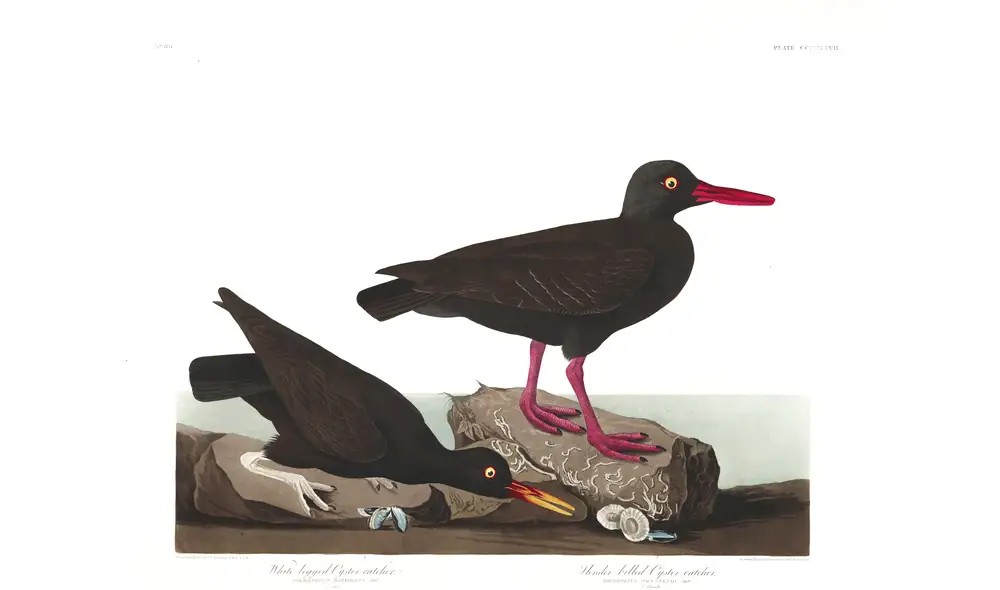
“White-legged Oyster-catcher, or Slender-billed Oyster-catcher”
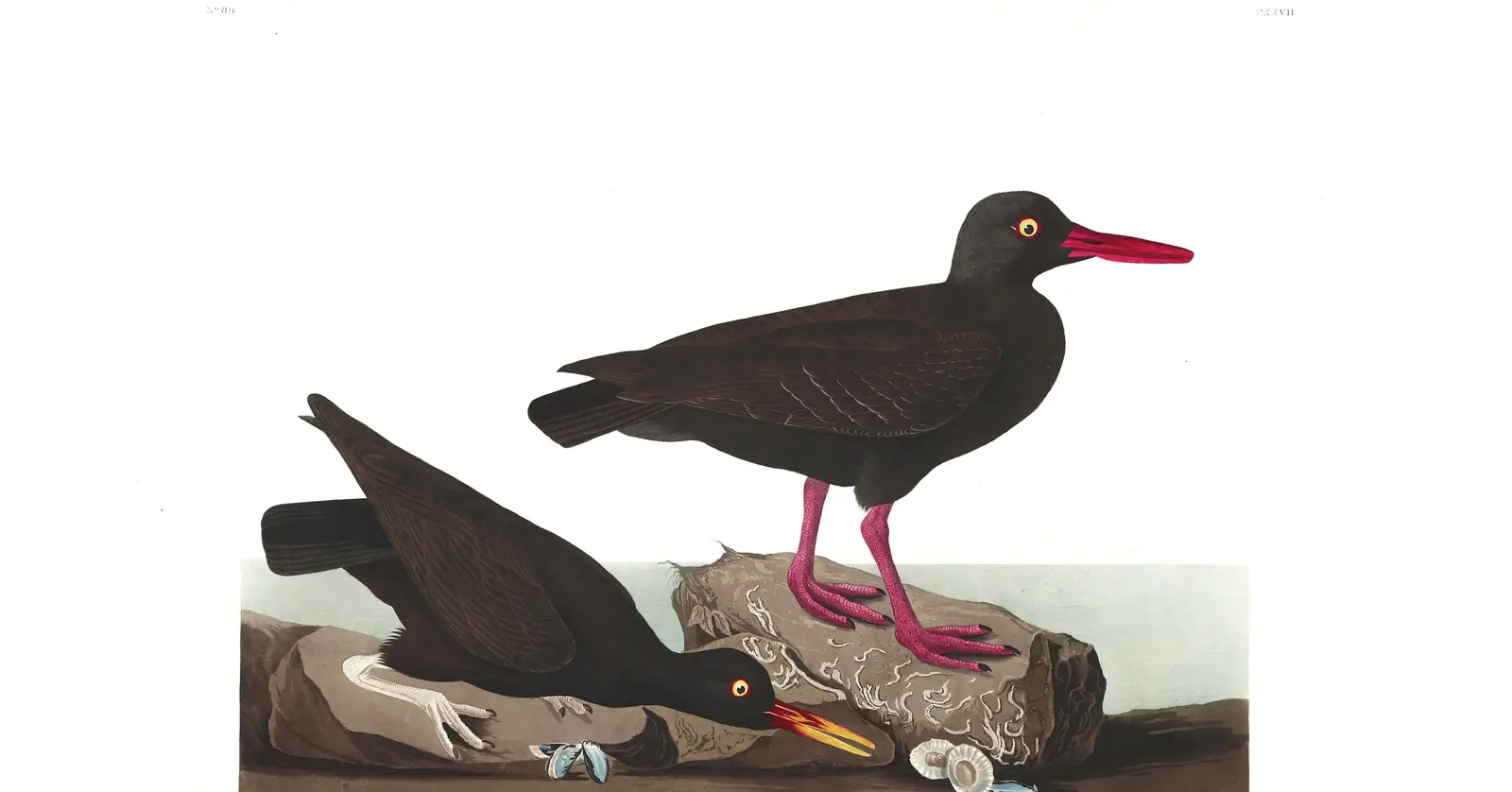
White-legged Oyster-catcher, 1. Male. | Slender-billed Oyster-catcher, 2. Female.
Modern identification
Figure 1. Male.
Printed “White-legged Oyster-catcher”
Haematopus bachmani
- Certain
- Oystercatchers · Haematopodidae
Why
Audubon's “White-legged Oyster-catcher” (Haematopus bachmani, fig. 1) is today's Black Oystercatcher, which he named on this plate
Sources
Featherframe havell.yaml; plate title from audubon.org; New-York Historical Society; Wikimedia Commons; Boston Public Library (Digital Commonwealth); Ridgway, Birds of North and Middle America viii (1919)
Figure 2. Female.
Printed “Slender-billed Oyster-catcher”
Haematopus ater
- Certain
- Oystercatchers · Haematopodidae
Why
Audubon's “Slender-billed Oyster-catcher” (Haematopus townsendi, fig. 2) is the South American Blackish Oystercatcher: its type, Townsend's skin in the US National Museum, came from his voyage round South America, and Sharpe, Ridgway and Hellmayr & Conover all list H. townsendi under H. ater. NYHS, Commons and the BPL name only the Black Oystercatcher
Sources
engraved legend; Audubon, Ornithological Biography v (1839); Sharpe, Cat. Birds Brit. Mus. xxiv (1896); Ridgway, Birds of North and Middle America viii (1919); Hellmayr & Conover, Cat. Birds Americas i.3 (1948)
Who made the plate
Drawn from Nature by J. J. Audubon, F. R. S. F. L. S.Engraved. Printed and Coloured by Robt. Havell, 1838.
- John James Audubon drew
- Robert Havell Jr. engraved, printed and coloured
As the credit line gives it. More on who made these plates.
